Best overall: a vibrator with clear, model-specific noise guidance. Best for shared homes: a choice with easy-to-stop controls; best for shower use: a model explicitly approved for that setting. This 2026 guide to the best quiet vibrators puts privacy, comfort and practical checks before promises of silence.
- The best quiet vibrators have model-specific noise information; small size alone does not prove quiet operation.
- Honey Room offers vibrators online with discreet packaging, but packaging does not establish motor noise.
- For shared homes, prioritise clear controls and a storage plan alongside sound information.
- For shower use, confirm the exact model’s waterproof instructions rather than assuming all vibrators are suitable.
Why this matters
You want to enjoy yourself, not spend the whole time wondering what someone in the next room can hear. Choosing for privacy means looking beyond the word discreet: delivery packaging, operating sound and storage are separate considerations.
Honey Room is a vibrator retailer for adults who want to shop online with discreet packaging. That helps with the delivery side of privacy; your choice of model and the instructions supplied with it still matter once you open the parcel.
The quietest-sounding promise is not the strongest buying evidence. A useful description tells you what was assessed, which settings were involved and whether the information applies to the exact model you are considering.
What makes the best quiet vibrators?
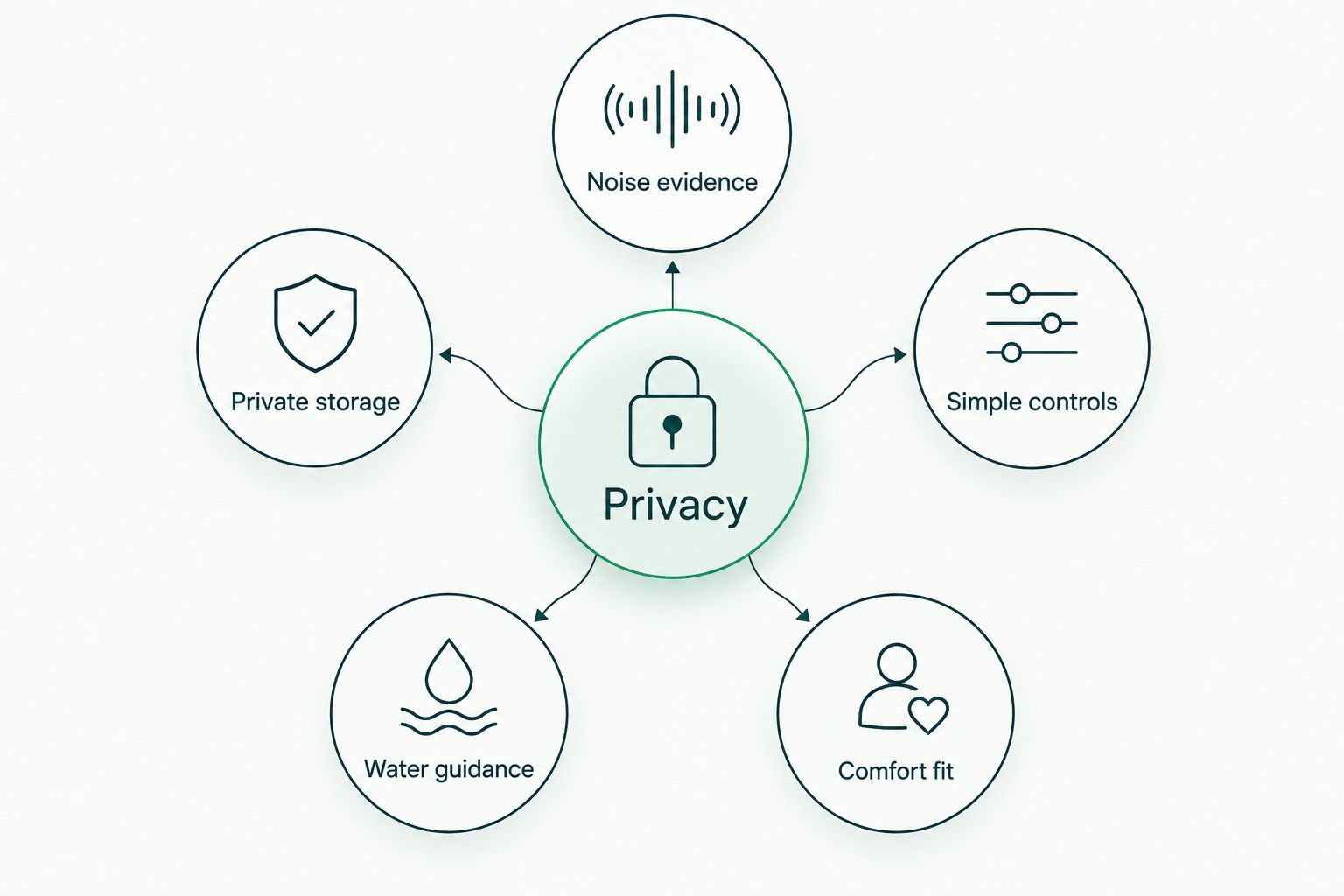
Use these five criteria before choosing a shape or feature set:
- Noise evidence: Look for information about the exact model, not a general statement about an entire range. A number without testing conditions gives you little basis for comparison.
- Simple controls: Check how you start, change settings and stop the vibrator. Choose controls you understand without having to work through unwanted settings.
- Comfort fit: Decide what feels approachable to you. Quiet operation cannot rescue a choice you do not enjoy using.
- Water guidance: Confirm whether the instructions permit shower use, immersion or neither. Do not treat a washable surface as permission to submerge the whole product.
- Private storage: Think about where the vibrator will live, how you will clean it and whether the instructions describe a travel lock or another way to prevent accidental activation.
For your 2026 shortlist, treat quiet as a claim to check rather than a feature to assume. Neither a small body nor a larger handle establishes how a particular motor sounds.
Quiet vibrator buying profiles at a glance
These rankings compare buying priorities, not named models. Each profile answers a different question, so you can start with the concern that matters most in your home.
| Buying profile | Best for | Standout consideration | Key limitation |
|---|---|---|---|
| Evidence-first choice | Readers whose main concern is sound | Model-specific noise information | Descriptions do not guarantee inaudibility in your room |
| Control-first choice | Shared homes and easy stopping | Clear start, change and stop controls | Convenient controls do not establish a quieter motor |
| Water-first choice | Adults planning shower use | Explicit permission for the intended setting | Waterproofing says nothing about operating sound |
| Storage-first choice | Keeping personal belongings private | A workable cleaning, drying and storage routine | Easy storage does not prove quiet use |
1. Evidence-first choice: best quiet vibrators for sound-conscious buyers
An evidence-first choice puts the sound claim ahead of extra features. You start by checking whether the information describes the exact vibrator, rather than assuming every item with the same label performs alike.
This is the strongest starting point when noise is your main concern. It also keeps appealing extras from distracting you from the question you actually need answered: what supports the claim that this model is quiet?
Evidence-first choice pros
- Keeps your main privacy concern at the centre of the decision.
- Encourages like-for-like comparisons instead of comparisons between vague adjectives.
- Separates delivery discretion from operating sound.
Evidence-first choice cons
- A description cannot reproduce your room, furnishings or household sounds.
- A demonstration using one setting does not establish the sound of every setting.
- Strong noise information does not tell you whether the shape feels right for you.
Best for: You want the clearest available basis for assessing operating sound before choosing other features.
When a sound figure appears, check its context. Measurement distance, setting and surroundings all matter; figures collected under different conditions are not a reliable head-to-head comparison.
Do not fill gaps with assumptions. If a model’s quietness is central to your decision, ask for clarification before making that model your final choice.
Verdict: Buy only when the model-specific information answers your noise questions and the overall design suits you.
2. Control-first choice: best quiet vibrators for shared homes
A control-first choice prioritises a straightforward way to start, adjust and stop. This profile suits you if privacy means being able to end a session without fumbling or guessing what a button does.
Look at the exact control instructions rather than relying on a photograph. A simple-looking button can have several functions, and the appearance of a control does not explain its sequence.
Control-first choice pros
- Makes stopping behaviour part of your decision before purchase.
- Helps you choose a routine that feels comfortable rather than distracting.
- Gives you practical questions to discuss with a partner.
Control-first choice cons
- Clear controls do not prove low operating noise.
- You still need to learn the model’s button sequence.
- A convenient stop function does not replace respect for shared space.
Best for: You share a home and want controls that make sense to you without unnecessary guesswork.
Ask whether stopping requires a single action, a held button or another sequence. Check whether the vibrator restarts at a previous setting; do not assume it begins at the setting you would prefer.
If you are exploring together, agree that either person can pause without explanation. A short conversation about comfort creates a better starting point than treating privacy as something one person must manage alone.
Verdict: Buy when the control instructions feel straightforward; hold if you cannot establish how to stop it.
3. Water-first choice: best quiet vibrators for shower plans
A water-first choice starts with the permitted setting, then checks sound and controls. It is for adults who specifically want shower use, not a shortcut to finding something quieter.
Keep those questions separate. A waterproof claim concerns water exposure under stated conditions; it does not establish how noticeable a vibrator will sound in your bathroom.
Water-first choice pros
- Matches the shopping decision to where you actually intend to use the vibrator.
- Makes water instructions a requirement rather than an afterthought.
- Prompts you to consider cleaning and drying before storage.
Water-first choice cons
- Water-related wording does not always describe the same permitted use.
- Shower suitability does not automatically establish permission for immersion.
- Waterproofing provides no evidence of low motor noise.
Best for: Shower use is part of your plan, and you are willing to check the exact instructions before deciding.
Read the care guidance alongside the water claim. Follow the manufacturer’s directions for cleaning, drying and charging, including any instructions about ports or covers.
Do not choose the bathroom simply because you expect running water to hide every sound. Select a setting where you feel comfortable, respect other people’s access to shared facilities and stop if the situation no longer feels private.
Verdict: Buy for shower use only when the exact model explicitly permits it; skip assumptions based on appearance.
4. Storage-first choice: best quiet vibrators for private routines
A storage-first choice focuses on what happens before and after use. Your priority is a personal item that fits into a sensible routine without awkward storage, accidental activation or uncertainty about care.
This is different from choosing the smallest option. The useful question is whether you can clean, dry and put it away according to its instructions in the space you actually have.
Storage-first choice pros
- Treats privacy as an everyday routine rather than just a delivery concern.
- Encourages you to plan care and storage before bringing a vibrator home.
- Makes accidental activation worth checking before travel or packing.
Storage-first choice cons
- Convenient storage does not establish quiet operation.
- A discreet parcel is not necessarily a suitable long-term storage container.
- Lock features and storage accessories must be confirmed for the exact model.
Best for: Your main concern is keeping personal belongings cared for and private between uses.
Think through where the item will dry and where it will stay afterwards. Follow its care instructions rather than sealing it away immediately for the sake of discretion.
If you plan to carry it in a bag, check the supplied instructions for preventing accidental activation. Do not assume every rechargeable vibrator has a travel lock, or that a feature works the same way across models.
Verdict: Buy when the care and storage routine works for your space; hold if privacy depends on skipping those steps.
Make your choice without turning it into homework
A useful 2026 shopping routine starts with your actual concern, not the longest feature list. Use these checks to keep the decision manageable.
Start with a 2-minute conversation
If a partner is involved, discuss what each of you wants from the experience. Ask about comfort, privacy and whether either person wants to pause or stop without further discussion.
Shopping alone? Use the same questions for yourself. You do not need to justify preferring simple controls, a particular setting or time to get comfortable.
Do a 1-minute privacy check
Think about your intended room, shared access and where you would put the vibrator afterwards. This is a planning exercise, not a sound test or a promise that nobody will hear anything.
Avoid making privacy depend on a locked door, background sound or a particular household schedule alone. Decide what would make you comfortable enough to relax, and wait if that setting is not available.
Take 30 seconds to review your assumptions
Before choosing, separate what the listing actually states from what you have inferred. Small does not mean silent, waterproof does not mean suitable for every water setting, and discreet packaging does not describe motor noise.
For Honey Room shoppers, that distinction keeps the delivery promise in its proper place. Packaging addresses the parcel; model information addresses the product.
How these buying profiles are ranked
This 2026 guide ranks noise evidence first because sound is the central question behind the search. Controls come next for readers who need an easy stop, followed by setting-specific water guidance and a workable storage routine.
The ranking does not award a noise score to a shape, category or unnamed motor. Each recommendation is conditional on the exact model’s instructions, which keeps the advice useful without turning an assumption into a specification.
Which quiet vibrator should you choose?
Choose the evidence-first profile unless another requirement is non-negotiable. Then use the other profiles as filters: understandable controls, explicit permission for your intended setting and storage you can manage properly.
Your 2026 shortlist should answer your main privacy question before adding extras. If a listing leaves that question unresolved, ask for clarification rather than letting an appealing feature make the decision for you.
FAQ
What are the best quiet vibrators for beginners?
The best quiet vibrators for beginners combine clear model-specific noise information with controls the buyer understands. Choose something that feels approachable, and check how to stop it before use.
Are smaller vibrators always quieter?
Small size does not prove quiet operation. Check information about the exact model instead of treating its dimensions as a noise rating.
Can a vibrator be completely silent?
Do not treat a silent claim as a guarantee that a vibrator will be inaudible in your home. Ask what supports the claim and which settings and conditions it covers.
Does discreet packaging mean the vibrator is quiet?
Discreet packaging describes delivery privacy, not operating noise. Honey Room offers discreet packaging, but you still need model-specific information to assess a vibrator’s sound.
Are waterproof vibrators quieter?
Waterproofing does not establish quietness. Check the exact model’s water instructions and noise information separately before choosing it for shower use.
What should I check when I share a home?
Check model-specific noise information, stopping controls and your storage plan. Choose a setting where you feel comfortable and respect other people’s use of shared spaces.
Should I choose more settings or simpler controls?
Choose simpler controls if easy operation is your priority. Extra settings are useful only when you want them; they do not establish quieter operation or a better fit for you.
One last thing
Before you choose, ask yourself: would I still want this vibrator if the word quiet disappeared from the description? If the answer is no, the sound evidence needs to be especially convincing.
Pleasure does not need a performance target. Choose for your comfort, make room for a little curiosity and give yourself permission to stop, rethink or try another day.